
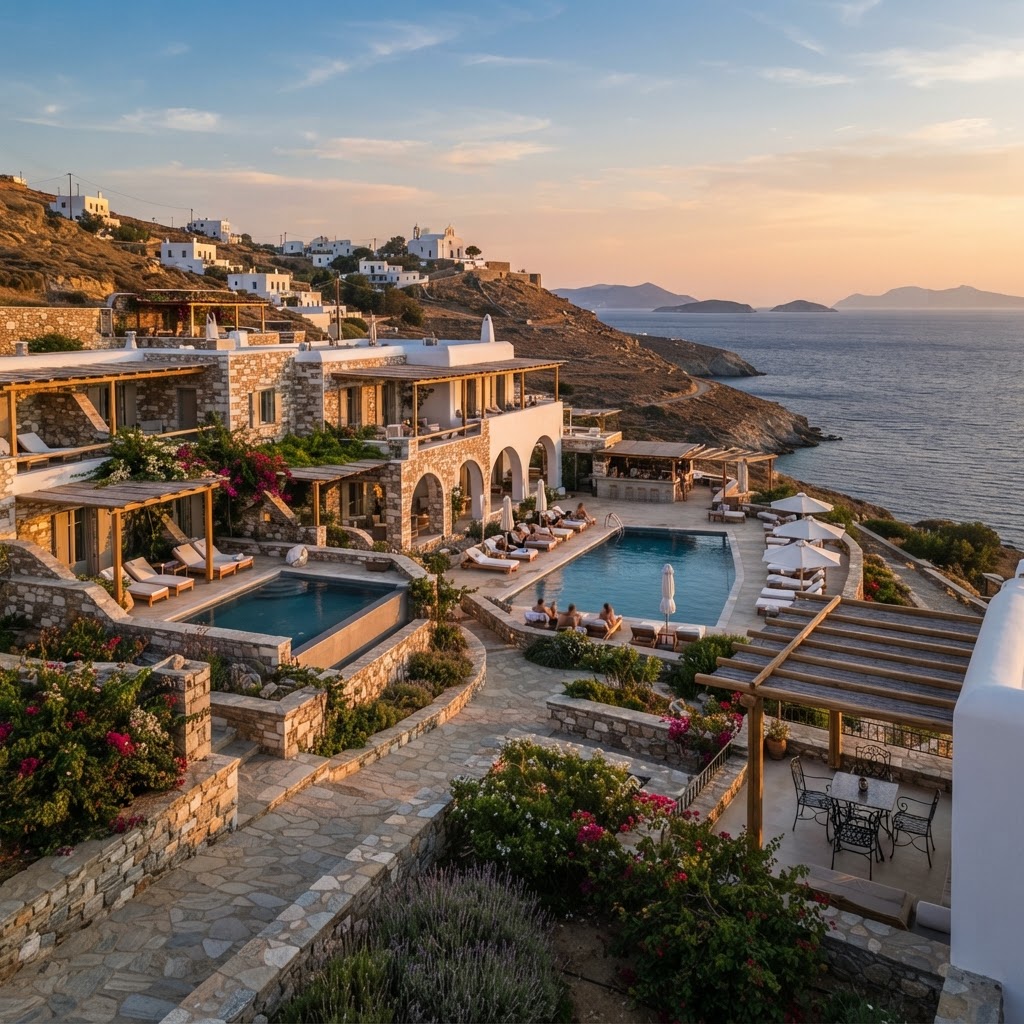
Buying a hotel in Sikinos Island, Greece offers investors a rare opportunity to acquire hospitality property on one of the Cyclades' most unspoiled and authentic islands. With fewer than 300 permanent residents and limited tourist infrastructure compared to neighbouring Santorini or Ios, Sikinos represents a frontier market for boutique hospitality investment. This comprehensive guide walks you through every stage of purchasing a hotel on Sikinos—from understanding the island's unique tourism dynamics and property availability to navigating Greek acquisition laws, securing financing, and positioning your investment for long-term profitability. Whether you're eyeing a traditional guesthouse in Chora, a coastal property in Alopronia, or a development opportunity with Aegean views, you'll find the expert frameworks, legal insights, and strategic considerations needed to make an informed purchase decision in this emerging Cycladic destination.
Key Takeaways
- Sikinos offers exceptionally low competition with only a handful of small hotels and guesthouses currently operating, creating first-mover advantage for boutique investors.
- Property prices on Sikinos remain significantly below Santorini, Mykonos and Paros levels, though liquidity is limited and transactions are infrequent.
- Greek non-EU buyers face no ownership restrictions but must obtain a Greek tax number (AFM) and work with a notary for all property transfers.
- The island's appeal lies in authenticity and slow tourism rather than mass-market volume, requiring a niche positioning strategy focused on cultural immersion and tranquillity.
- Infrastructure limitations including ferry dependency, limited banking services, and seasonal water supply must be factored into operational planning and due diligence.
- Planning permission for new builds or major renovations involves strict Cycladic architectural guidelines and can take 12–24 months to secure.
- Successful Sikinos hotel investments typically operate May–October with owner-operator models or strong local management partnerships to navigate the tight-knit island community.
Why Invest in a Hotel on Sikinos Island: Market Fundamentals and Tourism Profile
The Undiscovered Cyclades: Sikinos's Investment Appeal
Sikinos represents one of the last authentic investment frontiers in the Cyclades archipelago. With fewer than 250 permanent residents and an annual visitor count estimated at 8,000–12,000 arrivals in 2026, the island offers hospitality investors a rare opportunity to enter an emerging market before mass tourism reshapes its character.
Current accommodation supply consists of approximately 8–10 small-scale properties scattered between the port village of Alopronia and the hilltop settlements of Chora and Kastro. Total bed capacity sits below 150 across the entire island, creating persistent summer shortages when ferry connections improve and word spreads among discerning travellers. This supply-demand imbalance creates favourable conditions for investors who can calculate your potential returns based on premium pricing and high occupancy rates.
Visitor Demographics and Tourism Profile
Sikinos attracts a specific traveller archetype that hospitality investors should understand:
- Culture-seekers and history enthusiasts drawn to the 7th-century Zoodochos Pigi monastery and the Episkopi monument (a unique Roman-era structure converted to Byzantine church)
- Serious hikers exploring the island's network of ancient pathways connecting settlements
- Slow travel advocates seeking multi-day immersion rather than day-trip tourism
- Repeat Cyclades visitors who have exhausted Santorini, Mykonos and Paros
- Digital nomads and remote workers requiring reliable connectivity in tranquil settings
This demographic typically books longer stays (4–7 nights versus the Cyclades average of 2.5 nights), generating higher per-guest revenue and reducing turnover costs. The educated, affluent profile also supports premium pricing strategies that can significantly improve investment returns.
Seasonal Patterns and Occupancy Dynamics
The high season spans mid-June through mid-September, with August commanding premium rates despite limited inventory. Shoulder months (May, early June, late September, October) show growing strength as hiking conditions peak and cultural travellers avoid crowds. Winter remains dormant, though a handful of properties now experiment with year-round operation targeting the emerging "winter sun and solitude" niche.
Existing properties report summer occupancy rates of 75–90% with significant turned-away demand, suggesting immediate revenue potential for new entrants who can maintain quality standards. Forward-thinking investors can estimate their investment ROI by modelling extended seasons and premium positioning strategies that capitalise on unmet demand.
Competitive Positioning and Unique Selling Points
Sikinos occupies a strategic position in the tourism value chain:
| Competitive Factor | Sikinos Advantage |
|---|---|
| Authenticity | Working agricultural economy; genuine local culture undiluted by tourism |
| Accessibility | Regular ferry connections via Ios and Folegandros (2–4 sailings weekly in summer) |
| Pricing power | Limited supply allows premium positioning versus overcrowded alternatives |
| Development restrictions | Strict building codes preserve character while limiting new competition |
| Proximity to hubs | Day-trip accessible from Ios (30 minutes) for visitors seeking contrast |
The island's minimal commercialisation—no ATM until 2024, handful of tavernas, single minimarket—appeals to travellers fatigued by the homogenised resort experience. For investors, this translates to an opportunity to define hospitality standards in a market still taking shape, with potential to capture premium rates from guests willing to pay for exclusivity and authenticity.
Types of Hotel Properties Available on Sikinos and Where to Find Them
The Sikinos Hospitality Property Landscape
The scarcity of formal hotel inventory on Sikinos means buyers must approach acquisition creatively, understanding the distinct property categories and how each reaches market. The island's limited accommodation stock operates predominantly during peak summer months, making property selection crucial for investors considering off-peak revenue strategies to extend profitability beyond July and August.
Traditional Guesthouses in Chora and Kastro
The twin hilltop settlements harbour the island's most characterful hospitality assets. Traditional Cycladic houses built into the medieval kastro (fortress settlement) occasionally become available when families relocate or consolidate holdings. These typically feature:
- 3–8 rooms in interconnected cave-like structures
- Original stone vaulting and architectural details
- Panoramic sunset views toward Folegandros and Sifnos
- Existing tourism licences (EOT registration)
- Price range: €180,000–€450,000 depending on condition and capacity
These properties require sensitive renovation respecting heritage guidelines but offer immediate authenticity that purpose-built hotels cannot replicate. Their compact size and lower operating costs make them particularly suited to extended-season operation when managing seasonal demand through niche positioning such as yoga retreats or cultural immersion experiences.
Small Coastal Hotels in Alopronia
The port settlement contains the island's modest concentration of purpose-built accommodation. Alopronia properties typically comprise:
- 8–15 room capacity in 2–3 storey buildings
- Direct beach access to the island's main sandy shore
- Ground-floor taverna or café operations
- Easier logistics for supplies and guest arrivals
- Price range: €350,000–€750,000 for operational businesses
These assets suit investors seeking turnkey operations with established revenue streams, though architectural character may be less distinctive than hilltop alternatives. Beach proximity makes them dependent on summer trade, requiring careful consideration of seasonal operation patterns.
Renovation Projects in Abandoned Settlements
Sikinos contains several semi-abandoned clusters between main villages where stone structures await restoration. These represent:
- Multi-building complexes requiring comprehensive reconstruction
- Opportunities to create boutique properties of 6–12 rooms
- Lower acquisition costs (€80,000–€200,000) but substantial renovation budgets
- Permitting challenges requiring expert navigation of heritage and zoning rules
- Potential for unique positioning (wellness retreats, artist residencies, agrotourism)
Development Land Parcels
Rare buildable plots occasionally surface, particularly in designated tourism zones near Alopronia. Key considerations:
- Minimum 4,000 m² typically required for hotel development permits
- Building coefficient limits (often 0.2–0.3, meaning 800–1,200 m² structure on 4,000 m² land)
- Strict height restrictions (usually 7.5 metres maximum)
- Infrastructure requirements (water cisterns, septic systems, solar panels)
- Land prices: €40–€80 per m² depending on location and services
Family-Run Businesses and Private Sales
Most Sikinos hospitality transactions occur off-market through local networks. Family-run guesthouses rarely list publicly; instead:
- Owners sound out interest through taverna conversations and community channels
- Local lawyers and notaries (based in Sikinos or neighbouring Ios) act as informal matchmakers
- Timing often links to generational transitions or health circumstances
- Negotiations proceed slowly, requiring relationship-building and cultural sensitivity
Finding Opportunities: Practical Search Strategy
Stay4Hospitality aggregates Sikinos listings when they surface, but proactive buyers should:
- Engage regional Greek agents specialising in Cyclades hospitality (based in Syros, Naxos, or Athens)
- Establish local presence through extended visits, building relationships with municipality officials and business owners
- Monitor neighbouring island markets (Ios, Folegandros) where agents may have Sikinos intelligence
- Commission feasibility studies for development sites, demonstrating serious intent to landowners
The illiquid nature of this market rewards patience and local knowledge, making expert guidance essential for foreign investors.
Step-by-Step Process for Buying a Hotel in Sikinos Island
The Complete Acquisition Roadmap
Buying hospitality property on Sikinos demands methodical execution across ten critical phases, each requiring specialist input.
Step 1: Initial Research and Site Visits
Before formal engagement, conduct reconnaissance across multiple seasons:
- Visit during high season (August) to assess occupancy and guest profiles
- Return in shoulder periods (May or October) to evaluate year-round viability
- Interview existing operators about supply chains, staffing, and operational challenges
- Document infrastructure (water reliability, power stability, internet connectivity)
- Budget 7–10 days for thorough on-island assessment
Step 2: Engaging Greek Legal Representation
Secure a Greek-speaking lawyer experienced in Cyclades property transactions:
- Seek recommendations from Stay4Hospitality or established Greek hospitality investors
- Verify membership in Greek Bar Association (Dikigoros Syllogos)
- Confirm experience with tourism licence transfers and EOT compliance
- Typical legal fees: 1.0–1.5% of purchase price plus €150–€250 hourly for advisory work
Step 3: Obtaining AFM Tax Number
All property buyers require an AFM (Arithmos Forologikou Mitroou) tax identification number:
- Apply at nearest Greek tax office (DEF) or through lawyer with power of attorney
- Provide passport, proof of address, and purchase intent documentation
- Processing time: 1–3 weeks
- Open Greek bank account simultaneously (required for transaction completion)
Step 4: Property Identification and Preliminary Negotiations
Once targets are identified:
- Request comprehensive financial records (minimum three years for operational businesses)
- Obtain current property tax statements (ENFIA) and utility bills
- Verify tourism licences and occupancy permits are current
- Negotiate price, payment terms, and inclusion of chattels (furniture, equipment)
- Typical negotiation period: 3–8 weeks for Sikinos properties
Step 5: Signing Preliminary Contract (Prosynfono)
The prosynfono formalises purchase intent:
- Typically requires 10–30% deposit held in escrow or paid to seller
- Specifies completion timeline (usually 60–120 days)
- Includes conditions precedent (satisfactory due diligence, financing approval)
- Creates legally binding obligation on both parties
- Notary or lawyer drafts and witnesses signatures
Step 6: Comprehensive Due Diligence
This critical phase uncovers deal-breakers. Understanding the typical due diligence timeline helps you plan the acquisition schedule realistically.
Title Search (Ypothikofylakio Registry)
- Confirm seller's ownership and title clarity
- Identify any mortgages, liens, or encumbrances
- Verify property boundaries match physical site
Building Permits and Zoning Compliance
- Obtain building permit (oikodomiki adeia) history from Sikinos municipality
- Verify all structures are legal and properly registered
- Confirm current use aligns with zoning designation
- Check for outstanding building violations or stop-work orders
Debt and Tax Checks
- Request tax clearance certificate (Forologiki Enimerotita)
- Verify no outstanding property taxes (ENFIA arrears)
- Check for unpaid utility bills or municipal charges
Environmental and Archaeological Restrictions
- Confirm property not subject to archaeological protection orders
- Verify compliance with Natura 2000 or coastal zone restrictions
Budget 30–45 days for thorough due diligence on Sikinos properties.
Step 7: Securing Financing or Proof of Funds
Greek banks rarely finance foreign buyers of small island properties, so:
- Arrange international financing secured against home-country assets
- Prepare proof of funds documentation for cash purchases
- Factor currency exchange timing and costs (typically 0.5–1.5% of transaction)
Step 8: Final Notarial Deed Signing and Registration
The symvolaio (final deed) transfers ownership:
- All parties (or representatives with power of attorney) attend notary appointment
- Notary reads complete deed aloud in Greek (translation provided)
- Transfer tax (3.0% of declared value) and notary fees (≈1.0–1.5%) paid at signing
- Notary registers deed with land registry within 15 days
Step 9: Transfer of Utilities and Licences
Post-completion administrative tasks:
- Transfer electricity (DEI), water, and internet accounts
- Notify EOT (Greek Tourism Organisation) of ownership change
- Update business licences and insurance policies
- Register with local tax office as property owner
Step 10: Post-Acquisition Setup
Finalise operational readiness:
- Renew or transfer EOT tourism licence (requires inspection if property modified)
- Register with GEMI business registry if operating as legal entity
- Establish VAT registration and fiscal representation if required
- Hire or retain staff, updating employment contracts and social insurance
Total timeline from offer to operation: typically 4–7 months for Sikinos acquisitions, longer for complex renovation projects requiring new permits.
Legal Requirements, Ownership Structures and Compliance for Foreign Buyers
Foreign Ownership Framework in Greece
Greek property law offers unrestricted access to foreign hospitality investors, with identical rights for EU and non-EU nationals. The 2026 regulatory environment maintains this openness while imposing specific compliance obligations.
No Nationality-Based Restrictions
Unlike several Mediterranean jurisdictions:
- No special permits required for foreign ownership of Greek real estate
- No minimum investment thresholds for standard property purchases
- No residency requirements to acquire or operate hospitality businesses
- Equal legal standing with Greek nationals in property disputes and transactions
The only exceptions apply to border zones and military areas (not relevant to Sikinos).
Mandatory Notary Involvement
Greek law requires all property transfers pass through a licensed notary (symvoliografos):
- Notaries act as impartial public officials, not party representatives
- They verify title, calculate taxes, draft the deed, and register the transaction
- Notary fees are regulated: approximately 1.0–1.5% of declared property value
- Buyers and sellers typically split notary costs equally unless negotiated otherwise
Notaries also ensure compliance with anti-money laundering regulations, requiring proof of funds origin for transactions exceeding €15,000.
Capital Controls Legacy
Greece imposed capital controls during the 2015 financial crisis, creating transaction friction. By 2026:
- Controls are fully lifted for property transactions
- International wire transfers proceed normally
- However, Greek banks remain cautious with large cash deposits; expect enhanced due diligence on fund sources
- Maintain clear documentation trail from foreign bank accounts through to Greek notary escrow
Tax Residency Implications
Property ownership does not automatically create Greek tax residency, but:
- Spending 183+ days annually in Greece triggers tax residency
- Tax residents pay Greek income tax on worldwide income (progressive rates to 44%)
- Non-residents pay tax only on Greek-source income (rental/hospitality revenue)
- Property transfer tax (3.0% of declared value) applies to all buyers regardless of residency
- Annual property tax (ENFIA) based on location, size, and property characteristics (typically €800–€3,500 annually for Sikinos hotels)
Ownership Structure Options
Personal Ownership (Direct Title)
Suitable for small-scale investors:
- Simplest structure with lowest setup costs
- Owner personally liable for business debts and legal claims
- Income taxed as personal revenue (progressive rates)
- Inheritance subject to Greek succession law
- No annual compliance costs beyond tax filings
Greek Limited Liability Company (EPE - Etaireia Periorismenis Efthynis)
Traditional corporate structure:
- Requires minimum €4,500 share capital
- Limited liability protection for shareholders
- 28% corporate tax rate on profits (2026)
- More complex accounting and annual reporting requirements
- Setup costs: €1,500–€3,000 including legal and registration fees
- Suitable for multi-property portfolios or investor groups
Private Company (IKE - Idiotikou Kefalaiou Etairia)
Modern flexible structure introduced 2012:
- No minimum capital requirement
- Limited liability with simpler governance than EPE
- Same 28% corporate tax rate
- Lower ongoing compliance burden
- Setup costs: €1,200–€2,500
- Increasingly popular for foreign hospitality investors
VAT Registration and Compliance
Hospitality businesses must register for Greek VAT (FPA):
- Standard rate: 24% applies to accommodation services
- Reduced rate: 13% applies to food and beverage if separate revenue stream
- Monthly or quarterly VAT returns required depending on turnover
- Fiscal representation mandatory for non-EU owners without Greek tax residency
- Input VAT on renovation and equipment purchases is recoverable
Employment Law and Local Hiring
Operating a Sikinos hotel requires understanding Greek labour regulations:
- Seasonal employment contracts (March–October) are standard for hospitality
- Minimum wage 2026: €830 monthly (gross) for full-time employees
- Employer social insurance contributions add approximately 25–28% to gross wages
- Written contracts mandatory in Greek language
- Termination protections stronger than many jurisdictions; seek legal advice before dismissals
Cycladic Building Codes and Environmental Compliance
Sikinos falls under strict Cycladic architectural regulations:
Building Restrictions
- Maximum height: 7.5 metres (typically two storeys)
- Traditional Cycladic aesthetics mandatory: white walls, minimal external ornamentation
- Flat or low-pitched roofs; no pitched tile roofs permitted
- Window and door proportions regulated
- External materials limited to render, stone, and wood
Environmental Protections
- Coastal zone restrictions (within 50–100 metres of shoreline) limit development
- Wastewater treatment requirements (often requiring private systems)
- Water conservation measures (rainwater harvesting encouraged)
- Archaeological oversight: any excavation may trigger site inspection and potential work stoppage
Renovation Permits
- Building permit required for any structural changes, extensions, or use modifications
- Municipality approval timeline: 3–6 months for standard renovations
- Heritage properties may require additional approval from Ministry of Culture
- Review detailed planning permission requirements before committing to properties requiring significant renovation
Golden Visa Programme (Optional Benefit)
While not required for property purchase, investments of €400,000 or more (increased from €250,000 in 2023) qualify non-EU buyers for Greek Golden Visa:
- Five-year renewable residence permit
- Visa-free Schengen zone travel
- No minimum stay requirements
- Family inclusion (spouse, children under 21, parents)
Sikinos hotel purchases rarely reach this threshold individually but may combine with other Greek property holdings to qualify.
Costs, Financing and Budgeting for Your Sikinos Hotel Purchase
Understanding Sikinos Property Price Ranges
Sikinos represents one of the Cyclades' most affordable entry points for hospitality investors. Small hotels and guesthouse properties typically range from €150,000 to €600,000 based on 2026 market comparables, with pricing heavily influenced by location, condition, and existing infrastructure. A traditional stone building requiring full renovation near Chora might list at €180,000–€250,000, while a turnkey 6–8 room boutique hotel with sea views and modern amenities commands €450,000–€600,000. Properties in Alopronia port area often sit mid-range at €280,000–€400,000 due to ferry accessibility.
Understanding how much it costs to buy a hotel extends beyond the sticker price—factor in renovation requirements, infrastructure gaps, and the island's unique logistical challenges. Use our Property Valuation Tool to assess whether asking prices align with comparable Cycladic properties and revenue potential.
Transaction Costs and Professional Fees
Beyond the purchase price, budget carefully for Greece's mandatory transaction expenses:
| Cost Component | Percentage | Notes |
|---|---|---|
| Transfer tax (FMA) | 3.0% | Paid on declared property value |
| Notary fees | ~1.0% | Legally required for deed transfer |
| Legal fees | 1.0–1.5% | Essential for due diligence |
| Agent commission | 2.0–4.0% | If using property broker |
| Land registry fees | 0.5–0.8% | Title registration costs |
For a €350,000 hotel purchase, anticipate €24,500–€33,250 in closing costs alone—a critical figure often underestimated by first-time Greek property buyers. These expenses are non-negotiable and must be paid in full before title transfer completes.
Renovation and Infrastructure Investment
Many Sikinos properties are traditional Cycladic structures requiring substantial upgrades to meet modern hospitality standards. Budget realistically:
- Basic cosmetic refresh: €15,000–€30,000 (paint, furnishings, minor repairs)
- Mid-range renovation: €50,000–€100,000 (bathrooms, kitchens, electrical, plumbing)
- Complete restoration: €120,000–€250,000+ (structural work, new installations, pool, terraces)
Water infrastructure deserves special attention—installing private cisterns or desalination systems adds €8,000–€25,000 depending on capacity. Solar panel installations (increasingly essential given island electricity costs) range from €12,000–€30,000 for small hotel operations. Read our detailed analysis of Sikinos hotel energy costs and solar investment ROI to understand how renewable energy dramatically reduces operating expenses within 4–6 years.
Ongoing Operational Costs
Sikinos's remote location creates unique cost structures:
- Utilities: €400–€800 monthly (electricity significantly higher in summer without solar)
- Staffing: €1,500–€4,000 monthly during season (cleaners, reception, maintenance)
- Ferry logistics: €150–€400 monthly for supply runs to Santorini or Ios
- Marketing and OTA commissions: 15–25% of revenue
- Property taxes (ENFIA): €600–€2,500 annually based on property value
- Winter holding costs: €500–€1,200 monthly (utilities, maintenance, insurance)
Energy expenses warrant particular scrutiny—properties without solar installations face summer electricity bills of €600–€1,200 monthly during peak season. Water costs remain manageable with proper cistern management, though desalination units add €80–€150 monthly in electricity consumption.
Financing Options and Capital Requirements
Greek banks typically require 40–50% deposits for commercial property mortgages, with stricter criteria for non-EU buyers. Interest rates for hospitality loans hover around 4.5–6.5% in 2026, with loan-to-value ratios capped at 50–60% for island properties. Explore comprehensive financing options for purchasing hospitality properties to understand which structures work best for your situation.
Cash purchases dominate the Sikinos market—approximately 70% of transactions complete without mortgage financing. International private finance or portfolio lending offers alternatives, though expect higher rates (6–9%) and shorter terms. Non-EU buyers face additional documentation requirements including tax residency certificates, source-of-funds declarations, and sometimes Greek tax identification numbers (AFM) before mortgage approval.
ROI Expectations and Timeline
Realistic return on investment for Sikinos hotels:
- Gross rental yield: 6–12% annually (highly seasonal)
- Net yield after expenses: 3–7% for well-managed properties
- Break-even timeline: 8–15 years for cash purchases
- Capital appreciation: 2–4% annually (conservative estimate)
Successful operators achieve higher returns by extending seasons through autumn, cultivating repeat guests, and maintaining premium positioning. The low-volume, high-margin model suits investors prioritising lifestyle over aggressive financial returns. Properties with solar installations and water independence consistently outperform on net yield by reducing operational overhead by 18–25% annually.
Due Diligence Essentials: What to Verify Before You Buy
Title Verification and Land Registry Checks
Begin with a comprehensive land registry search (Ktimatologio) to confirm clean title and ownership history. Sikinos properties often carry complex inheritance patterns—verify that all co-owners have consented to the sale and no outstanding claims exist. Request your lawyer obtain:
- Certificate of ownership (pistopoiitiko ktimatologiou) showing current registered owner
- Encumbrance certificate confirming no mortgages, liens or legal disputes
- Boundary survey validating exact plot dimensions and any easements
- Historical ownership chain identifying previous transfers and potential complications
Properties without full cadastral registration (still common on smaller islands) require extra scrutiny—ensure the seller provides notarial deeds proving unbroken ownership back at least 20 years.
Building Permits and Planning Compliance
Many traditional Sikinos structures predate formal permitting systems, creating regulatory grey areas. Your due diligence must establish:
- Building permit status (oikodomiki adeia): Verify all structures have valid permits or qualify for retrospective regularisation
- Planning zone classification: Confirm the property sits within settlement boundaries or designated tourism zones
- Permitted use: Ensure current tourism licensing matches actual building permissions
- Illegal additions: Identify any unauthorised extensions, terraces or outbuildings requiring legalisation
- Archaeological restrictions: Check proximity to designated archaeological zones (Sikinos has Bronze Age and Roman sites)
Engage an engineer or surveyor familiar with Cycladic building regulations to assess compliance—regularising illegal construction can cost €5,000–€30,000 and delay operations by 6–18 months.
Structural Condition and Earthquake Resilience
Sikinos lies in a seismically active region—structural integrity directly impacts insurance costs and safety. Understanding what hotel buyers look for before making an offer helps prioritise these critical verification items:
- Commission a full structural survey examining foundations, load-bearing walls, roof condition
- Assess earthquake damage history and any previous repairs or reinforcements
- Verify damp-proofing and waterproofing, especially in stone buildings near the coast
- Inspect wooden elements (beams, lintels, shutters) for rot or termite damage
- Evaluate retaining walls and terracing stability on sloped plots
Budget €800–€1,500 for professional structural assessment—essential protection against costly surprises.
Water Rights and Sewage Systems
Water infrastructure represents a critical vulnerability on Sikinos. Given the island's limited natural water resources, thorough verification of Sikinos hotel water supply, desalination and infrastructure proves essential:
- Confirm water supply source: Municipal connection, private well, or cistern-based system
- Verify water rights if property claims well access (increasingly restricted)
- Assess storage capacity: Calculate if existing cisterns meet peak season demand
- Inspect sewage system: Determine if connected to municipal network or relies on septic tank (and its condition/capacity)
- Check wastewater treatment: Verify compliance with environmental regulations
Properties without reliable water access may require €10,000–€40,000 investment in cisterns, pumping systems or desalination—factor this into your budget.
Tourism Licensing and Capacity Verification
Validate all operating permissions:
- Current tourism business licence (EOT registration) showing permitted room count and classification
- Fire safety certificate (pistopoiitiko pyrosfaleias) confirming compliance
- Health and safety approvals from relevant authorities
- Tax registration (AFM) and VAT status
- Guest capacity limits matching physical rooms and planning permissions
Request copies of recent tax returns and occupancy records to verify the business operates legally and matches seller claims.
Municipal Charges and Outstanding Liabilities
Obtain clearance certificates (ekkatharistika) confirming:
- Zero outstanding property taxes (ENFIA)
- No unpaid municipal charges (water, waste collection)
- Current status on community fees if part of shared development
- No pending legal actions or planning enforcement notices
Sellers should provide these pre-completion—their absence signals potential hidden liabilities that transfer with the property.
Common Pitfalls and How to Avoid Them When Buying on a Small Greek Island
Underestimating Isolation and Logistics Challenges
Sikinos receives limited ferry service—typically 3–5 connections weekly outside peak summer months. New owners frequently misjudge the operational impact:
Common mistakes:
- Assuming year-round easy access for supplies, staff and maintenance contractors
- Failing to stockpile essentials before winter ferry reductions
- Underestimating costs of emergency repairs requiring specialist tradespeople from larger islands
- Neglecting backup systems for critical equipment (generators, water pumps)
How to avoid: Build 15–20% logistics buffer into operating budgets. Establish relationships with Santorini or Ios suppliers willing to coordinate with ferry schedules. Maintain comprehensive spare parts inventory. Plan major renovations during shoulder seasons when contractor availability and ferry access align. Understanding ferry connectivity and seasonal accessibility patterns proves essential for operational planning and guest experience management.
Overestimating Occupancy Without Marketing Infrastructure
Sikinos attracts roughly 8,000–12,000 visitors annually—a fraction of Santorini's millions. Investors often project unrealistic occupancy:
Dangerous assumptions:
- Expecting 70–80% occupancy based on popular Cycladic islands
- Believing "build it and they will come" without active marketing
- Underestimating OTA commission impact (15–20% on small islands with limited direct booking culture)
- Assuming repeat business develops quickly
Reality check: Well-marketed Sikinos hotels achieve 45–60% annual occupancy, concentrated in June–September. Budget €8,000–€15,000 annually for professional photography, website development, OTA optimisation and targeted digital marketing. Cultivate niche positioning—wellness retreats, hiking holidays, authentic Cycladic experience—rather than competing on generic beach tourism.
Skipping Thorough Structural Surveys
The allure of traditional stone buildings blinds buyers to hidden structural problems:
- Foundations undermined by water infiltration or poor drainage
- Load-bearing walls compromised by previous amateur renovations
- Roof structures requiring complete replacement (€15,000–€40,000)
- Moisture damage invisible behind cosmetic finishes
Protection strategy: Never waive structural surveys to "save" €1,200. Engage engineers with specific Cycladic stone construction experience. Include survey contingency clauses in purchase contracts allowing price renegotiation or withdrawal if major defects emerge.
Failing to Budget for Off-Season Holding Costs
Sikinos operates a 4–5 month primary season. Seven months of minimal revenue still incur substantial costs:
- Property maintenance and winter weatherproofing
- Utilities (reduced but ongoing)
- Insurance, taxes and professional fees
- Security and periodic property checks
- Retained staff or caretaker arrangements
Financial discipline: Calculate full 12-month cash flow projections assuming zero revenue November–March. Maintain operating reserves covering 8–10 months of holding costs. Consider winter closure strategies versus low-season niche marketing (yoga retreats, artist residencies) to generate modest off-season income.
Neglecting Local Community Relationships
On an island of approximately 300 permanent residents, reputation matters profoundly:
Integration failures:
- Ignoring local hiring practices and community expectations
- Dismissing traditional protocols around property boundaries, water rights, access paths
- Operating without participating in island life and cultural events
- Failing to learn basic Greek or show cultural respect
Success approach: Invest time in genuine community integration. Hire locally where possible. Support island businesses. Participate in festivals and community initiatives. Consult long-term residents about property plans. The goodwill generated directly impacts operational success—from securing reliable maintenance help to guest recommendations from locals. Addressing staff recruitment and accommodation challenges requires understanding local labour dynamics and housing constraints that shape hiring strategies on small islands.
Ignoring Water Scarcity and Waste Management Realities
Sikinos faces chronic summer water stress. Buyers accustomed to mainland abundance encounter:
- Municipal supply rationing during peak season
- High costs for tanker water delivery from neighbouring islands
- Guest complaints about water pressure or availability
- Environmental regulations limiting wastewater discharge
Mitigation strategies: Prioritise properties with substantial cistern capacity (minimum 50–80 cubic metres for 6–8 rooms). Install water-efficient fixtures. Consider greywater recycling for gardens. Educate guests about water conservation. Budget €200–€500 monthly for supplementary water purchases during July–August peaks.
Assuming Easy Exit Liquidity
Sikinos hospitality properties represent highly illiquid investments:
- Buyer pool limited to niche investors seeking authentic, remote locations
- Average listing-to-sale timeline: 18–36 months
- Significant price concessions often required for faster sales
- Seasonal viewing limitations (most buyers visit May–September)
Realistic expectations: Purchase Sikinos property with minimum 10-year holding horizon. Avoid over-leveraging based on optimistic resale assumptions. Maintain property meticulously to preserve value. Build operational track record and guest reviews that enhance resale appeal. Accept that exit timing depends on finding the right buyer, not market liquidity.
Next Steps: Tools, Resources and Expert Support for Your Sikinos Hotel Purchase
Explore Current Sikinos Hotel Listings
Begin your investment journey by reviewing available properties on Stay4Hospitality's dedicated Sikinos marketplace. Set up customised listing alerts to receive immediate notifications when new hotels, guesthouses or hospitality businesses become available. Our platform provides detailed property information, verified imagery, and direct seller contact—streamlining your initial research phase.
Filter listings by:
- Price range and property size
- Location (Chora, Alopronia, coastal versus inland)
- Condition and renovation requirements
- Current operational status and licensing
Vetted Professional Network
Successful Sikinos purchases require experienced local professionals familiar with island-specific challenges:
Recommended Greek property lawyers:
- Specialists in Cycladic island transactions with English/international client experience
- Proven track record handling complex title issues and permit regularisation
- Direct relationships with Sikinos municipal authorities and land registry
- Typical fees: 1.0–1.5% of purchase price plus disbursements
Notaries and surveyors:
- Notaries licensed to practice in the Cyclades (legally required for deed execution)
- Structural engineers with specific stone building and earthquake assessment expertise
- Architects familiar with traditional Cycladic design and modern hospitality standards
Stay4Hospitality maintains a curated directory of verified professionals—contact our advisory team for personalised referrals matching your transaction requirements.
Downloadable Resources and Planning Tools
Access our comprehensive buyer's toolkit designed specifically for Greek island hotel purchases:
Due diligence checklist (PDF download):
- 47-point verification framework covering legal, structural, operational and financial aspects
- Sikinos-specific considerations (water, ferry access, community integration)
- Timeline templates for coordinating surveys, legal work and completion
Financial planning spreadsheet (Excel template):
- Purchase cost calculator including all transaction fees
- 5-year cash flow projection model with seasonal revenue patterns
- Renovation budget planner with Cycladic construction cost benchmarks
- ROI and break-even analysis tools
Site visit planning guide (PDF download):
- Ferry schedule optimisation from Athens, Santorini and other hubs
- Essential questions for sellers and property viewings
- Local contact directory (municipal offices, utilities, contractors)
- Accommodation and logistics recommendations
All resources available through your Stay4Hospitality account dashboard.
Related Investment Guides and Market Intelligence
Deepen your knowledge with our interconnected guide library:
- Greek Hotel Licensing and Permits Guide: Navigate EOT registration, tourism classifications and compliance requirements
- Cyclades Hospitality Investment Overview: Compare opportunities across Sikinos, Folegandros, Amorgos and lesser-known islands
- Financing Strategies for International Hotel Buyers: Explore mortgage options, private finance and capital structuring for Greek properties
- Operating a Seasonal Island Hotel: Practical strategies for maximising occupancy, managing off-season costs and building repeat business
- Greek Property Tax and Legal Framework: Understand ENFIA, VAT, income tax and ownership structures for foreign investors
Each guide provides 2,500+ words of expert analysis, case studies and actionable advice—building comprehensive investment knowledge.
Stay4Hospitality Investment Advisory Services
Our specialist advisory team offers personalised support throughout your Sikinos acquisition:
Initial consultation (complimentary):
- Investment objectives assessment and property matching
- Market overview and realistic expectation-setting
- Timeline and process explanation
- Professional network introductions
Transaction support services:
- Property sourcing beyond public listings (off-market opportunities)
- Negotiation strategy and offer structuring
- Due diligence coordination and document review
- Completion management and post-purchase operational setup
Ongoing partnership:
- Property management referrals and operational consulting
- Marketing and distribution channel optimisation
- Exit strategy planning and resale support when appropriate
Schedule your consultation through the Stay4Hospitality platform—connect with advisors who've facilitated over €45 million in Greek island hospitality transactions.
Ferry and Logistics Planning
Practical site visit preparation:
Ferry connections (2026 summer schedule):
- Athens (Piraeus) to Sikinos: 5–8 hours via conventional ferry, 3–4 weekly
- Santorini to Sikinos: 1.5–2.5 hours, 4–6 weekly connections
- Ios to Sikinos: 45–90 minutes, daily service peak season
Recommended visit duration: Minimum 3–4 days to view properties, meet professionals, assess locations and experience island operations firsthand.
Local contacts: Stay4Hospitality provides island liaison services—local representatives who can coordinate property viewings, arrange meetings with municipal officials, and facilitate contractor consultations during your visit.
Join the Stay4Hospitality Investor Community
Connect with fellow hospitality investors through our private forums and networking events. Share experiences, exchange insights and access collective knowledge from operators managing properties across the Greek islands. Monthly webinars feature successful Cycladic hotel owners discussing real-world challenges and proven strategies.
Your Sikinos hotel investment begins with informed preparation—leverage these tools, resources and expert support to navigate your purchase with confidence.
Frequently Asked Questions
Related Resources
- Greek Island Hotel Investment Guide
- Sell Your Hotel on a Greek Island
- List Your Property with Instant Valuation
- Calculate Your Hotel Value Online
- Explore Hotels for Sale Worldwide
- Sikinos Island Tourism Seasonality and Off-Peak Revenue Diversification Strategies
- Sikinos Hotel Energy Costs and Off-Grid Solar Investment ROI
- Sikinos Island Hotel Staff Recruitment and Accommodation Challenges
- Sikinos Hotel Ferry Connectivity and Seasonal Accessibility Impact on Revenue
- Sikinos Island Hotel Water Supply and Desalination Infrastructure Analysis
- Sikinos Island Hotel Planning Permission and Building Restrictions for Buyers
- How much does it cost to buy a hotel?
- What financing options are available for purchasing hospitality properties
- What Do Hotel Buyers Look For Before Making an Offer?
- How long does hotel due diligence typically take
- Calculate your potential property value
- Estimate your investment ROI
Reader Feedback
Share your thoughts on "Buying a Hotel in Sikinos Island, Greece Guide". Feedback is reviewed by AI and must relate to this topic before it's published.